
-
5.0 Stars ⭐⭐⭐⭐⭐ 628 Google Reviews

Frederic
-
Posts
9,305 -
Joined
-
Last visited
-
Days Won
481 -
Country
Belgium -
Carnity Points
4,394 [ Donate ]
Content Type
Profiles
Forums
Advice
Complete Onboarding & Agree to Club Rules & Guidelines
Marketplace
STORE
Events
Gallery
Blogs
Everything posted by Frederic
-

Cristian has been promoted to Fewbie Plus level
Frederic replied to Gaurav's topic in Off-Road Club's Announcements
Well done @Cristian !! -
Well done @PETELCZYC PAJERO - luke ! Time to put those gloves to work! 😁
-
Essam Ibrahim has been promoted to Fewbie level
Frederic replied to Gaurav's topic in Off-Road Club's Announcements
Well done @essam ibrahim !! -
Easy, just head over to any hardware store and get some of these nitril gloves: They exist in so many brands and models / sizes.
-
untilDRIVE DETAILS Level: Fewbie Plus and above When: 9 September 2023, Saturday Meeting time: 6AM - Deflated and Ready to go Meeting Point: https://goo.gl/maps/FVLixGinNMWgbiKy5 Approximate finish time: 10AM Type of Car: Any proper 4x4 with front and back tow hooks and 8-10 inches of ground clearance. What to bring along: Loads of water, snacks (for yourself), smiles, enthusiasm, and willingness to learn.
-
DRIVE PLAN Request every member that joins this drive to go through the information below and strictly follow these guidelines, etiquette, and responsibilities. MUST READ AND COMPLY Environmental Policy Offroad Flag Guideline Two Way Radio Guideline Off road Driving Etiquettes Emergency details for all off roaders Off Road Driving - Roles & Responsibilities DRIVE DETAILS Level: Fewbie Plus and above When: 9 September 2023, Saturday Meeting time: 6AM - Deflated and Ready to go Meeting Point: https://goo.gl/maps/FVLixGinNMWgbiKy5 Approximate finish time: 10AM Type of Car: Any proper 4x4 with front and back tow hooks and 8-10 inches of ground clearance. What to bring along: Loads of water, snacks (for yourself), smiles, enthusiasm, and willingness to learn. MANDATORY OFF-ROAD GEAR: Tire deflator & Tire pressure gauge Compressor Walkie-talkie radio Off-road flag Shovel, Tow Rope & 2 Shackles First-aid kit Fire extinguisher LIMITED SPOTS AVAILABLE This drive is limited to 10 cars only. RSVP will close on Friday If the RSVP is full, you can add your name to the waitlist, once anyone drops, you will be moved to the RSVP list. RSVP will close a day prior to preparing a convoy list. Latecomers will be returned - Without any exceptions. Members without RSVP will be returned - Without any exceptions. Please withdraw your RSVP, if you aren't joining, so your spot can be taken by others. Repeated no-show members after RSVP will have their account suspended for a month. PLEASE RSVP ON BELOW CALENDAR
-
EB4C092C-DE19-4CDD-A220-475E5A173BAB.jpeg
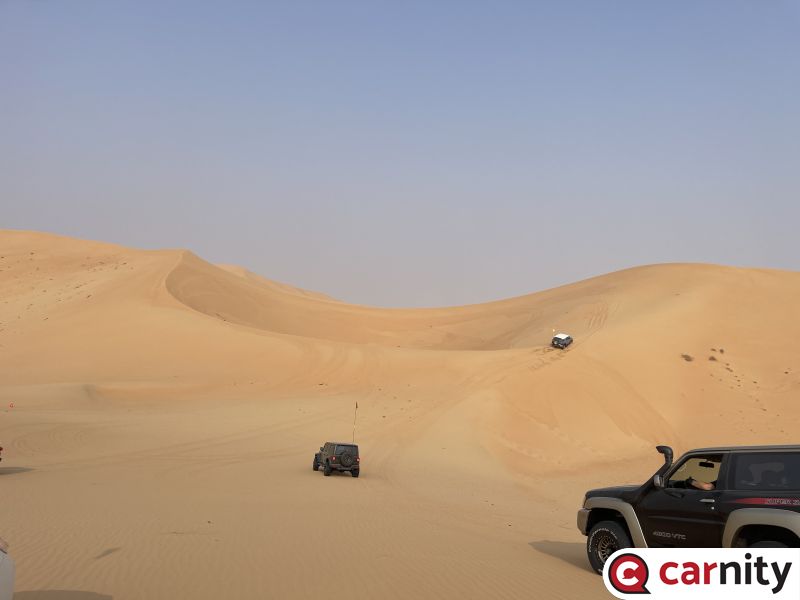
Frederic posted a gallery image in Fewbie Plus - Rockin' in Remah - Abu-Dhabi - 02 Sep 2023
-
Drive Report Waking up early can be painful, and summer drives can be brutal. That's why some of us decided to stay in the area overnight so we could arrive well rested. Once the weather finally cools down we will be able to camp again and that's something i am really looking forward too. With a convoy mix of relatively new Fewbie plussers, and very experienced drivers, we set off to the large dunes located north of the camel race track. This area is not spoilt by crosstracks so we could hop from one bowl to another and rev our engines to our heart's desire. And so we did ! Some small refusals that were easily dealt with, and a pop-out that took slightly longer as the balancing weight was causing the tire rim not to close properly, gave us some rest to chit-chat and socialize. Little by little the temperatures were rising so we kept moving where we could, and to keep ourselves and our engines cool. While i have been in this area before, this time i kept finding more and more nice dunes with large climbs, drops, and wonderful ridges to throw our cars over The convoy behind me took it all with pleasure and the fresh Fewbie Plussers amongst you drove superbly ! @Mohit Gurnani you felt you'd be having a bad day, but you drove amazing this morning. The pop-out in your case could have happened to anyone so no need to worry about that one. @FERNANDO SYRIO you had to push the pedal to the metal and you did ! The Fortuner flew through every obstacle and your big smile said enough well done my friend ! @Santoso Marjuki you were the most perfect second lead, smile from ear to ear but yet always focused and ready to help out. Thank you so much ! @Hugo i absolutely love your FJ and attitude ! well done buddy ! @Amr Aydin feels home at any place in the convoy and lays his tracks marvelously! Good to see you back my friend. @Mario Cornejoand @Zed got the freedom at the back to find their own tracks and with that combined experience i am sure you guys had good fun ! We exited at the well-known Sweihan underpass, and while inflating i was thinking about doing a drive from Al Hayer (Dubai-Al ain Road, all the way to the Telal Resort from where we started. That would takes us through both Sweihan and Remah area. What do you guys think ? Will start planning for it as soon as the weather cools down a bit. See you all in the sand again !
- 9 replies
-
- 11
-

-

-

-

-
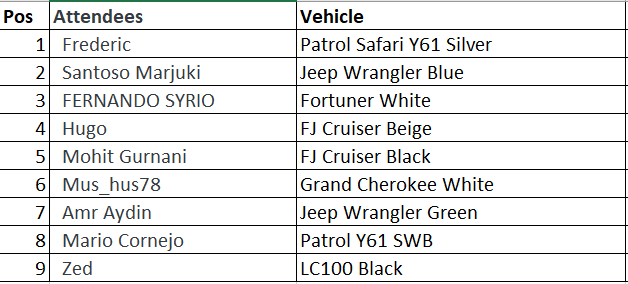
TGIF Today ! @Santoso Marjuki@FERNANDO SYRIO@Hugo@Mohit Gurnani@Mus_hus78@Amr Aydin@Mario Cornejo@Zed Great to have you all joining tomorrow! I know it's quite early, but the terrain is worth it in my opinion. We will be using Channel 4 - 446.081 Mhz. Please make sure to bring your offroad tools, good protection from the sun, and a full tank. See you all tomorrow morning !
-
on your Y61 there are no side airbags i presume, so i agree it's better and safe to leave them activated.
-
There are usually two types of airbags installed in your car: 1. Front airbags (in your steering wheel). 2. Side airbags / curtain airbags / lateral airbags. Airbags are usually being triggered by two possible events, either a heavy impact on the front bumper, or when the car is tilting too much on one side, followed by a quick tilt towards the other side. This is something we do whenever we are ridge riding and crossing over from one side to the other (also called switching). Some vehicle brands have very sensitive sensors to detect this kind of tilting, and hence trigger the airbag to go off during your dune-bashing drive. Cars like Ford, Land Rover, GMC, Dodge, Chevy seem to be very prone to this, hence we always advise to disable the airbags. Ideally, you'd want to keep your frontal airbag activated, as it's there to protect you in case of a nasty nose-dive. Unfortunately, in many 4x4's this fuse is combined with the side airbags, so when deactivating side airbags, your front will also be disabled. It's up to you to decide if you want to keep your frontal airbag enabled or disabled. It's there to protect you in case of a nosedive or heavy impact from the front side, but when it goes off it will be an expensive repair, or you'll need to cut them out.
-
@DP1011@Mario Cornejo Correct, i installed a kill switch initially under the bonnet itself, but later removed it again and put everything stock. So i just use the regular "Traction Off" button on the center console, and the VDC disable hack next to brake pedal.
-
Car model: Nissan Patrol Y61 Safari 2021 Kill Switch Button: No Traction Off Button: Yes, on the center console VDC (Vehicle Dynamic Control) Off Button: Can be disabled by pushing the switch nearby the brake pedal. Airbags turn off button (if yes where to locate) : No, i remove the fuse on higer level drives. Other comments : Traction Off and VDC off will need to be repeated when restarting the vehicle or going from 4L back to 4H
-
Good morning @Johannes Roux I noticed you signed up for this drive, but you are currently at Fewbie level, so you are unfortunately not eligible to join. If you have completed 10FB level drives, you can request a promotion via below link: REQUEST PROMOTION
-
Came across the following discussion: https://www.cruzetalk.com/threads/chevy-cruze-turns-off-while-driving.8869/page-2 one of the comments: “Two things to look into: the negative battery cable. It's a known issue in the Gen 1. The other one is the ignition relay. Cheap part ($8?), easy to change(in the fuse box) One person here found that was the problem in his car.”
-
Benefits of tank in an onboard compressor
Frederic replied to Alphin Aloor's topic in General Discussions
Having said that, my neighbor sold his truck yesterday which had a twin-ARB mounted inside, and he removed it. If anyone is interested in this one (perhaps used less than 10times), send me a message on 0 5 6 5 0 4 2 6 3 2 I think he will be open for a good deal. -
Benefits of tank in an onboard compressor
Frederic replied to Alphin Aloor's topic in General Discussions
The ARB onboard twin is definitely a nice setup for any offroader and takes away the hassle of using an external compressor. If you compare with your big red dragon mart compressor, i do not believe it will be faster, but you save some time in not having to setup the connections and battery clamps. Most ARB built-in models use a auto-shutoff, so it stops pumping when there is no flow. I think this is a good option to have. I have not seen anyone using the tank. Most use the ARB twin model mounted underneath the seat or in the back, without the tank. -
Hi @AnasArifwhile we are not allowed to mention businesses or workshops here on the forum, there has been a similar discussion recently about this topic: @Vishnu Ramankuttyand @FERNANDO SYRIO drive the same model Fortuner as yours and went through the same questions to protect the front bumper in a better way. I would indeed advise to check with them what they have used, you can approach them on the drive or send them a quick whatsapp message if they are willing to share their mobile no.
-
the 2009 has the 3.8 engine which was not bad but the later model (2012 onwards I think )3.6 Pentastar engine is the one you really want. (200hp vs 280hp).
-
Definitely keep an eye on the regular replacement of the transmission fluid, but this counts for auto transmission too The clutch pedal should feel quite hard. If at one point you feel it is becoming softer and softer, it might mean your clutch plate is worn.
-
Stumpy Paj has been promoted to Intermediate level
Frederic replied to Gaurav's topic in Off-Road Club's Announcements
Well deserved @Stumpy Paj !! -
Issam Atra has been promoted to Fewbie level
Frederic replied to Gaurav's topic in Off-Road Club's Announcements
Well done @Issam Atra ! XJ all the waaaaay !! -
Faraz94 has been promoted to Fewbie level
Frederic replied to Gaurav's topic in Off-Road Club's Announcements
Well done @Faraz94 !! -
Ben Williams has been promoted to Fewbie level
Frederic replied to Gaurav's topic in Off-Road Club's Announcements
Congrats @Ben Williams !! -
Hey @Sreenath G Of course you can drive a manual gearbox in the dunes. I even prefer it over automatic. For an Xterra it's definitely rare, and probably lots of fun, @Anoop Nair, @Srikumar, myself, and few others drive manual gearboxes. The advantages: 1. No automatic upshifting. You and only you decide which gear you want to drive in. 2. Less weight in comparison with an auto gearbox which will mean better performance and less delay (no torque converter). Disadvantages: 1. Little bit more difficult to learn and you will probably burn 1-2 clutches by the time you get fully used to it.