
Leaderboard



Popular Content
Showing content with the highest reputation on 04/07/2025 in all areas
-
I’d like to open a thoughtful discussion among us off-road enthusiasts about a topic that, while often overlooked or even considered somewhat taboo in our community, deserves our attention: the environmental impact of our shared passion. As we all know, our regular dune drives, overlanding adventures, and off-road excursions contribute to our individual carbon footprints—often in ways we don’t fully consider. From the fuel we burn to the overseas shipping of custom parts, vehicle maintenance, and other resource demands, our hobby has tangible environmental consequences. Lately, I’ve found myself reflecting on a few important questions: Are we truly doing everything we can to ensure that future generations will be able to enjoy this planet as we have? Can we look ourselves in the mirror and honestly say we've made a sincere effort to reduce our impact? Will there come a time when we transition from petrol-powered 4x4s to more sustainable ways of exploring the desert—such as electric off-roaders, bikes, or even hiking? Is the change I make simply a drop in the ocean—or could it inspire others to act as well? To give a concrete example, a V6 petrol 4x4 driving approximately 10,000 km per year emits around 300g of CO2 per kilometer. That’s roughly 3 tons of CO2 annually, accounting for approximately 15% of an average individual's yearly carbon footprint. And let’s be honest—this is a hobby, not a critical necessity. There are tools and methods available to offset this impact, such as investing in reforestation or supporting verified carbon offset projects. It’s something worth exploring and discussing within our community. You can learn more at carbonfootprint.com. Beyond offsetting, we could also consider alternative activities that still foster our sense of community: hiking and camping trips, stargazing gatherings, and social meetups that don't require long drives or burning excessive fuel. Interestingly, areas like Al Qudra—once a favorite nearby off-roading spot—are now harder to access due to increasing vegetation. As a result, we often find ourselves driving an extra 50–60 km just to reach open dunes. Maybe this, too, is a subtle message from nature. I hope we can have an open, mature conversation about this. I’ve never considered myself an environmental activist, but as I grow older, these concerns are becoming harder to ignore. Let’s talk, share ideas, and see how we can evolve our passion in a way that respects the world we explore.9 points
-
@Frederic was a truly superb drive with the usual great lines and well thought out plan. always enjoy your drives allowing me to relax at the back Great support from a truly amazing team, in @Emanuel and @Imteeaz always a pleasure to drive with you guys and see how you have grown into leaders, and congrats @Imteeaz on your 100th drive with Carnity. The convoy drove exceptionally well throughout the drive, I believe we did not have any stucks (that i can remember) and just a handful of refusals that were expertly dealt with by the aforementioned support guru's. Hope to see you all in the sand again very very soon,4 points
-
It’s been a while that I have driven with @Frederic and what a great drive. I brought a passenger to convert him and he was reasonably impressed. Great to see @Davie Smooth_Operator back and roaring about at the rear, directly behind me. Thanks @Emanuel @Imteeaz for the support to the long convoy. It was a great morning drive. The pop out was resolved quickly with great team work. @Tanveer Ahmedi hope the tyre did not present any issues on the drive back. It was my great pleasure to drive behind @J-P L The Jimny was brisk and nimble. I had to dig deep to keep up. see you all next time and have shared some photos in the gallery
 4 points
-
https://we.tl/t-mK5kWPdzWA Guys in the link is some footage. I’ll try to post some more if time permits as it is not that smooth of a process due to the limitations on large file sharing on the Carnity page. @Emanuel @Paul Eldho @Krinesh4 points
-
Interesting topic @Frederic In my line of work, shipping, I see recent and future international legislation to compensate for the fuel used transporting goods. The main question that is still a bit vague is what is done and where these funds end up. From what I can see so far, is that the idea and facilities how to contribute are there, yet the end result of these contributions are unclear to say the least. I feel that until that question remains unanswered to my satisfaction, for my personal fuel usage I will not be participating in offsetting my carbon footprint by purchasing available credits just yet. Current alternatives directly usable for petrol/gasoil engines are rather limited and sparse in availability. On top of that there are significant concerns how "used" used cooking oil is and how sustainable large palm (FAME), corn/sugar plantations (ethanol) are, if used for fuel purposes. At the same time the "green" EV evolution seems to be in line with various government initiatives. However, as long as countries are still very reliant on fossil fuels, read coal, to produce the electricity that is required for these, I feel that if looking at source to final usage, petrol is probably not the worst pollutant overall. Taking in account the effect of mining coals and or materials for batteries the environmental impact seems worse. Recycling of special minerals at this point are also quite labor and energy reliant, so the effects on those should not be underestimated. There are ofc various initiatives in the world producing electricity on a more sustainable way: solar panels, wind or water turbines, but also these all come with some (negative) impact on local fauna or flora, disregarding the resources required for manufacturing. In short, I think the main area where the required resources should be assigned is R&D. Not for quick fixes or moving the source of pollution to another area or further up the production chain. What that means for me personally; keep myself informed on latest developments and ensure I implement improvements over which I have immediate control: change lightbulbs, more efficient heating/cooling, put in energy measuring points, turn off appliances when not in use, absolute no littering, recycle as much is possible and try to plant another tree!!3 points
-
Great topic @Frederic, I am also somehow concerned about sustainability. Not a fundamentalist but I think about that (probably because I'm also getting older😁). I believe many others in and out of Carnity are also. So, following what you mentioned about offseting our footprint, I suggest that Carnity could have an option in its fees for, whoever wants, pay a little extra to offset our drives' carbon footprint. And with all the money gathered, Carnity would invest in a platform to offset, and could inclusively mention that in its marketing material. A little bit like the airline tickets with an extra payment for who wants to offset that flight's carbon footprint. Just food for thoughts.3 points
-
I am not a green activist by any stretch of imagination but more of a petrol head, which conflicts with the former. I do camp a few times a year to enjoy what nature has to offer. Carbon footprint notwithstanding from our drives, I do not my little bit by not throwing rubbish in the desert when I am out and about. Some years back, there were desert clean up drives organized to clean up the desert. Small initiatives but it is a good one. Perhaps, we could reintroduce such initiatives during the cooler months.2 points
-
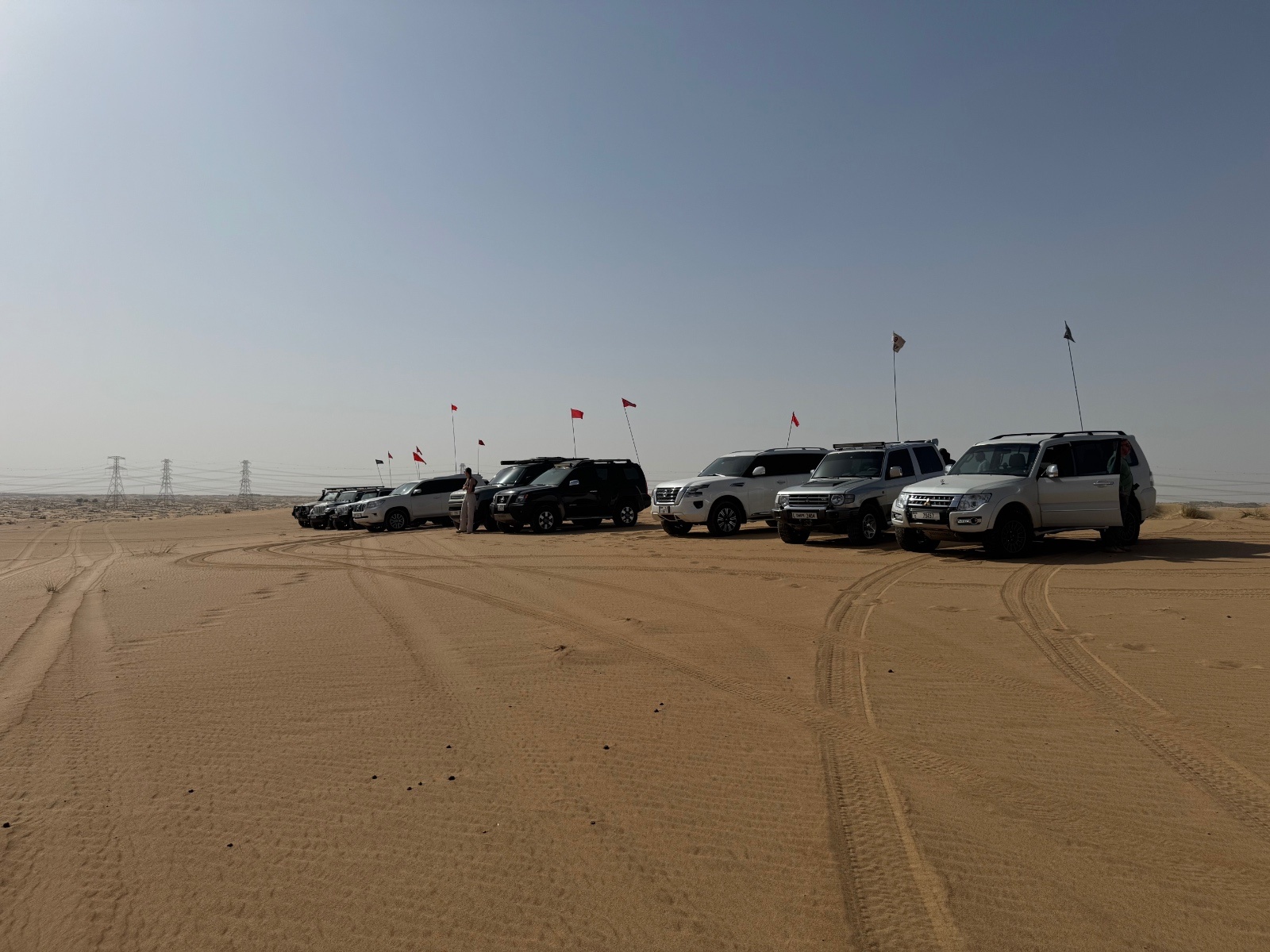
Thank you all for joining guys ! Everyone made it perfectly on time, and after a short briefing we headed out into this lesser-known area, even though we came across some cross tracks here and there. I believe the terrain offers various challenges, from the vegetation in some areas, technical narrow dunes, and also some beautiful dramatic bigger dunes. All in all perfect for a morning out with a fantastic team. Despite the big convoy, we only had a handful of refusals and no stucks, which shows the strength and capabilities of all of you. Well done!! With a superb support team, in @Emanuel@Imteeaz and with @Davie Smooth_Operator in the back pushing us forward, i could focus looking ahead trying to find the next clean area Congrats to @Imteeaz for completing his 100th drive with us. Next to his brilliant support qualities, you are a super skilled off-roader and genuine bliss to have you amongst us. See you all soon back into the sands !
 2 points
-
Hi @M.Seidam - was on the plane at 19:00, once landed i could unfortunately get only on the waitlist… hope you can extend a bit the list of participants from the waiting list brgds Zsolt1 point
-
Thanks for opening the floor for such an interesting topic @Frederic. You have my vote, as a rule of thumb, for anything above and beyond just steering the wheel on sand for 4 hours. For any event within your list of suggestions, consider me as the first one to sign up. From my perspective, I would look at it beyond the sustainability lens as it will eventually become a bi-product on how we evolve our hobby with the outdoor. I will share my 2 cents hoping to trigger some ideas on how to take things forward, under the main umbrella of your topic. Here goes: What I think complements the hobby of "Steering the Wheel on sand for 4 hours a.k.a Dune bashing is a sense of purpose. I call it Purposeful Driving. Purposeful driving can range from anything ranging from Theme drives such as the one led by @DP1011 to clean up pink rock, to driving to remote places (Overlanding) or adventures of any sort (Driving is the just the means of transportation in this case.) On a personal level, my objective of learning how to drive on sand was to benefit from the outdoors of the UAE. While this remains my objective to date, I have noticed many outdoor enthusiasts start with the same objective and then get stuck in Dune Bashing mode probably because it becomes their new comfort zone or they are genuinely drawn into this activity. I think based on the number of people who are stuck on Dune Bashing is the former reason (Just a personal opinion). Trying to keep this as short as possible or this might end up to be a rant of 5 pages, the point I am trying to make is to invite drivers to think of the concept of "Purposeful Driving" and think about what was the original idea(s) that got them to learn how to drive on sand and re-focus on those ideas. By doing so, what is intended to achieve with sustainability becomes a bi-product. Hoping that the above is taken with an open mind and by no means am I criticizing the hobby of dune bashing. I do it with Carnity as well, almost on a weekly basis, but all I am saying is that I do it to keep my driving skills sharp for the other things I like to do, that have a purpose. Once we establish purposeful driving, then that will have a good impact on the carbon footprint and different kinds of hobbies and events will emerge from it. Just my 2 cents...1 point
-
Your approval and recognition is much appreciated and I commit to respect the guidelines and rules of the community. Looking forward to next!1 point
-
congratulation dear Sam , really i am very happy to hear that , wishing you all the best , sorry, today only i came to know . essam ibrahim1 point
-
Thanks all for a great Saturday afternoon! Well driven by all the newbies! Here is a pic of our route yesterday.
 1 point
-
Thanks for the nice drive guys!1 point
-
Thank you all for the beautiful drive lots of learning points and my colleagues for the patience. Welcome @Kashx2, nice first drive1 point
-
Thank you all for making my first ride very memorable. I wanted to apologize over the radio for being late. I didn’t know what the rules are for personal messages so I hope everyone accepts my apology on the chat here.1 point
-
Thanks again @Gaurav, @Aser, @Rajiv Sam and @Fabien Monleau for a very enjoyable ride, great way to spend the afternoon. Hope to see you out again soon!
 1 point
-
This will be drive 100 for @Imteeaz. Must find a great spot for a team photo to mark the occasion.1 point
-
So I’ll promise to stop spamming the air compressor threads soon! 😬😂 I recently upgraded my onboard air, and as part of that, installed the ARB Pressure Control and an air tank. The air tank does not make anything appreciably faster. But there is a logic which I’ll explain… ARB Brushless Compressor, pressure controller, manifold and valves (going up to a reel air hose mounted on the roll cage). This setup will be made tidier once the line adaptive arrives and I can remove the manifold and connect the line directly to the solenoid valve block. Air tank mounted to the underside of the car, roughly placed under the driver’s side passenger footwell. The ARB pressure control is a nice-to-have in that you can hook up a four-hose line, preset the desired pressure and leave it running automatically while you go and do other stuff (…take down flag, pack gear away, swat flies, send the other half increasingly fictitious reasons as to why you’re running late to the afternoon event that you totally forgot about). However the controlling algorithm is really dumb! Most auto inflation systems would do something like this: 1.) Measure the pressure 2.) Apply pressure for a short period of time (say 10 seconds) 3.) Measure the pressure again and guesstimate the time required to reach the target pressure (based on measured pressure now, target pressure, and pressure gained during the short fill) 4.) Do a long fill for half the time you expect to need 5.) Stop, measure (should be roughly halfway to target pressure), recalculate, go again. 6.) Stop, measure, fine tune to target pressure - done The ARB controller instead stops every 15-20 seconds and measures the pressure. This stop-start is short, but if you have the compressor directly connected to the line, you’re cycling the pump on and off repeatedly (solenoid valve closes, pump runs until it quickly hits the 150 PSI cut-off, turns off until solenoid valve opens again). If however you have an air tank in the mix, when the ARB controller closes the valve to measure the pressure, the pump can keep going and top up the air tank. When the valve opens you get a quick extra burst of pressure, and the pump runs continuously. Testing on a like-for-like basis, the time to inflate my 4 x KN02’s from 7.5 PSI to 35 PSI did not change without (manual method, by hand) and with an air tank (with ARB controller); however with an air tank, the pump ran continuously and did not pressure cycle repeatedly. There are some secondary benefits - using air tools and having a quick burst of pressure for a stubborn pop-out…but this would be a rare use case I expect.

 1 point







This leaderboard is set to Dubai/GMT+04:00