
Leaderboard



Popular Content
Showing content with the highest reputation on 01/25/2024 in all areas
-
Thanks to @Davie Chase who will lead the second convoy, so extended the drive RSVP. @Aser @Salim Akhtar @Sandeep Nayar @Guido Ferriani @Nizar Shawwa @Andrew John Melvill @GabrielH @Wilfredo Perez and @TIMMY you have been moved to RSVP. Please confirm if you still like to join this drive.5 points
-
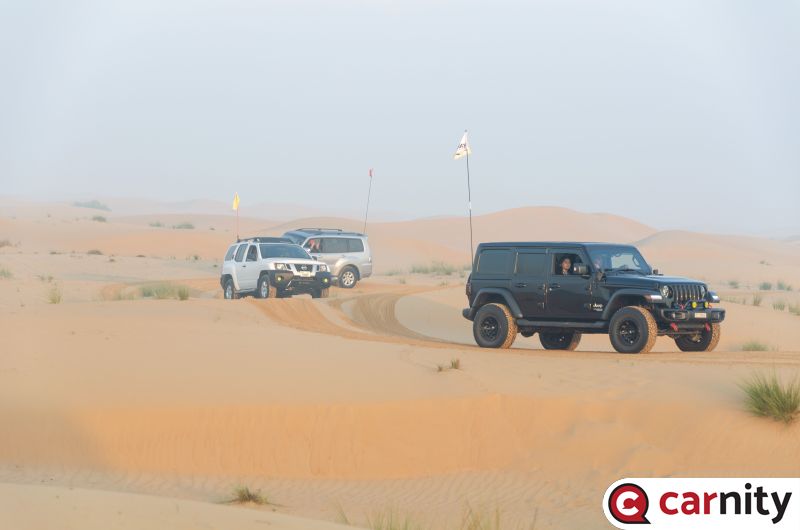
Dear Desertnauts in preparation for tomorrow's Traffic Jam drive, we'll tackle the tighter dunes of Qudra's southern quadrant from the Bab al Shams road. Reach the third roundabout on the road from Qudra's Last Exit to Bab al Shams, turn back toward Qudra and exit at the first opening through the guard-rail, and follow the track to the meeting and deflation point. Kindly reach the meeting point a little ahead of the starting time, so we may leave punctually. We will line up the convoy as follows: @Pacific in Second Lead @sohinik at #3 @Dev_ at #4 @Dr Tanveer Ahmed at #5 @Arravind at #6 @Anoop Nair at Center @MohamedSherif at #8 @frederic demolder at #9 and @Robk in Sweep. Tips on technical driving will be given before the drive, so that we may tackle the crowded and misaligned dunes, separated by soft shallow sand bowls, with patience and skills. Looking forward to seeing you tomorrow.3 points
-
Thank you so much Gaurav, but I have changed my plans. Will remove me from the list. Cheers. Guido.1 point
-
Wow! Thats 23 cars so far. Gonna be a fun one, welcome to all new members.1 point
-
Dear Desert Drivers, Thank you for signing up to the drive on Saturday Morning. I have updated the meeting point. The intent is to avoid spending too much time in the crowded area close to the road, move East in the direction of the Old Lady Dune, and from there, if we have sufficient time and good conditions, cross to the Al Ain Airport area and exit South on the E22. I will issue the convoy order tomorrow by the end of the afternoon. Let me know before that in case you changed your plans1 point
-
Enjoy your first drive @TIMMY1 point
-
Hi @Gaurav, confirming the below: My car: Ford Expedition timberline 2022, forged green color Experience: no prior experience Tow hooks: confirmed front and rear tow hooks. Air Compressor: I have an air compressor for inflation. Flag and Radio: confirmed flag and radio. MUST WATCH: watched Looking forward to the drive.1 point
-
Sorry @Gaurav I won’t be able to1 point
-
1 point
-
Hi @Gaurav, Confirmed1 point
-
Hi Gaurav! - I have a 2015 Black Toyota Fortuner - I've driven with another club about 10 times and completed their basic course - Yes, I have tow points - I have a flag and radio - Video, watched 👍 Looking forward to the drive!1 point
-
Sorry to miss you @Ranjan Das. See you soon hopefully1 point
-
Congratulatios @Dan S well deserved 👏1 point
-
two right makes it true right...! lol1 point
-
Oh never knew this. I have faith in Japanese engineering that the warning light must have a safety tolerance right....... right????😜1 point
-
This could lead to faster fuel pump failure, due to overheating, as fuel inside the tank also works to keep the fuel pump cool when fully submerged. Good to see you here @Jeh1 point
-
On the highest squelch level, your radio keeps picking up even the smallest of noises? Do you keep getting distracted by static noise during your drive? Then you need to adjust the internal squelch levels. This tutorial is valid for Baofeng models UV5R, UV82, F8HP, and 82HP. It is not valid for models UVB5/B6 or BF888S. You will need to: - purchase the Baofeng USB programming cable - download CHIRP The fix needs a bit of programming (that's why the USB cable), but it's easy enough and all the steps are explained in detail in this article: Adjusting the internal Squelch Levels - UV5R / UV82 / F8HP / 82HP series TL;DR The factory's internal squelch level settings have long been known to have little or no impact on the actual squelch range. The smallest noise burst would easily open the squelch regardless of setting 0 through 9. Most standard Baofeng factory squelch levels range from a low of 14-22 to a high of 40-48, both of which are low, and offer very little variation of squelch levels.1 point
-
Really good documentation !!1 point
-
I was able to capture @DP1011's maiden fewbie drive as lead at Lisaili, hope you will enjoy it. Do leave your comments on the YouTube website.1 point
-
1 point
-
1 point
-
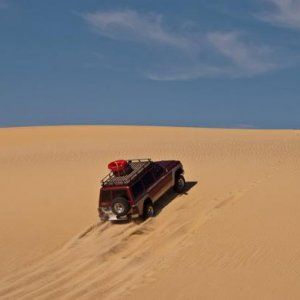
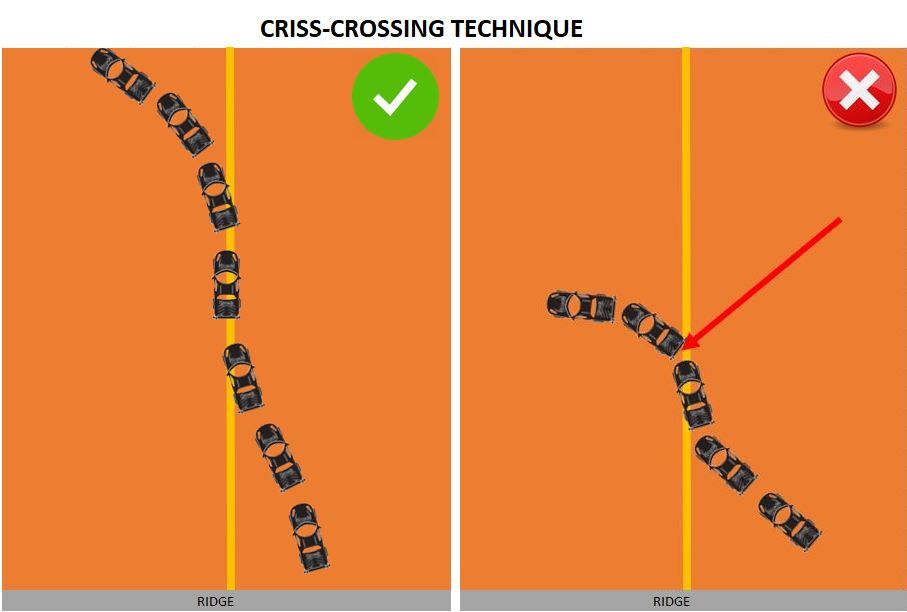
Different ways of crossing sand dunes Throughout the Carnity Offroad briefings you might have heard the terms "straight up and straight down", "side sloping", or "criss-crossing", and these are basically different techniques that we use in desert for crossing the sand dunes. Each come with its own risks and by learning and understanding the technicalities behind them i hope we can all learn faster and get more confidence in executing them. I hope below tutorial gives a more clear understanding on the subject and we can use it for future reference. 1) Straight Up - Straight Down Carnity Offroad Level: Newbie and Fewbies Description This technique is one of the very first we learn to apply when learning offroading. The trick is to approach the dune straight up with "JUST" enough momentum to make it through, but not too much to damage bumpers or cause a jump. One should always take into account the resistance that the sand offers based on different areas, and even more on different seasons. Most sand dunes have two sides - The windward side, which is the side where the prevailing wind blows on, and can be recognized by the wavy lines of the sand. This is the side where we ride on because the sand is more compacted and firm to drive on. - The slip-face side, this the softer backside (smooth side, no lines) of the dune which is generally not recommended to climb on, but this technique can later be learned as you advance through the off-road levels (slip-face attack). How to tackle It is advisable to start off at the bottom of the dune with applying a decent amount of power, and start letting go of the gas once you have climbed 75% of the dune. By that point the momentum should carry you further, and as soon as the car front wheel touches the crest, leave the gas completely or apply a bit of gentle braking when needed, to let you slide on other side of the dune safely. In fact the perfect technique is finding that right amount of momentum that you don't even need to apply brakes on the other side. Some gentle blips of throttle can help at the top to push you over the edge, as you learn and master this first step. If you run out of momentum going upwards to cross the dune, do not worry or panic, this is called a REFUSAL. Gently reverse and slowly come back in a straight line as you have climbed up. Announce on the radio that you have a refusal. Reverse up far enough so you can take a second attempt but this time with a bit more momentum. Risk Level: Low to medium. Approaching too slow will increase refusal and might cause stuck at the crest. Approaching with excessive speed might damage the bumpers or cause a vehicle to jump. Apply gentle throttle and slowly increase after learning. Take note that every dune is different and each approach will need to be made slightly different in terms of speed. Associated Risks: If you approach the dune too fast, more likely you will cause the bumper damage because your reaction time will be reduced substantially at very high speed. 2) Side-Sloping Carnity Offroad Level: Fewbie and upwards Description This technique is very fun and addictive, but it needs to be executed with a clear mind and a good experience on the behavior of the car. That is the main reason why this technique is only used from Fewbie level onwards. It is very critical to understand how gravity works and as we always says: " DO NOT FIGHT GRAVITY ". this applies to this technique most of all. When you approach a dune that you want to side-slope on, you need to carry enough momentum to get you through. This does not necessarily mean FULL throttle, because that depends on the type of dune. As soon as your car is on an incline, it will have the natural tendency to try to come down. The more momentum you carry, the further you will get. It is extremely important that you do not fight this by going higher up the dune at that point, but to steer down in a smooth way. Braking at this point is also very dangerous. While doing side sloping try to choose smooth path as possible and avoid stepping on rock, bushes or bumps that can bounce you and disturb the whole balance and tip you off or result in dangerous fish-tailing or tire pop-out at high speed. EVERY MOVEMENT OR ACTION YOU DO WHILE SLIDE-SLOPING NEEDS TO BE DONE IN A SMOOTH WAY, SUDDEN BRAKING OR EXTREME STEERING CAN LEAD TO ROLL-OVERS. Best practice: Always visually mark the entry and exit of the dune that you wish to do side sloping on. Stick to the initial plan as far as possible and exit safely. If you are new to this, then watch and observe how others have done before and try to replicate that as much as you can. The best thing to keep in mind is to think about "HALF MOONS" What i mean with that is that you should never make 90° turns during any kinds of these activities, but make smooth half moons during approaching dunes or crossing them. Risk Level: Medium. With proper training and guidance you can eliminate the risk of a roll-over for 95%, but one should always be aware of the risks involved and take all measures possible to minimize these. Keep both hands at the steering wheel and your full attention on the view ahead. Do not get distracted ! Associated Risks: If your vehicle is lifted more than 4 inch of OEM stock height then your 4x4 center of gravity will be less, and this will increase the risk of roll-over or flip by 50%. Same goes for bouncy (non-standard/rated) suspensions. 3) Criss-Crossing Carnity Offroad Level: Fewbie and upwards Description Criss-crossing is the art of riding the ridge of the dune and crossing over to the other side. Also here it is vital to understand that the approach towards the ridge, as well as the crossing over needs to be done in a smooth, half moon way. So basically you approach the dune along the length, you can stay on the ridge for as long as you want, but don't lose momentum at this point, or you will be crested lengthwise in the exact middle. Now the trick is to choose the right point at which you cross towards the other side. This feels scary at the beginning, but soon you will get the hang of it, and cross ridges without panicking at all. Make the criss-cross movement again in a half-moon method as seen below. Below picture shows the right and wrong way to criss-cross a dune. On the left side you will see that the approach is smooth and as soon as you cross over to the other side you gently steer down. Braking at this point is again very dangerous. In the right-side scenario, the angle of approach is very sharp, and during higher speeds this can result in a roll-over. EVERY MOVEMENT OR ACTION YOU DO WHILE CRISS-CROSSING NEEDS TO BE DONE IN A SMOOTH WAY, SUDDEN BRAKING OR EXTREME STEERING CAN LEAD TO ROLL-OVERS. Risk Level: Medium. With proper training and guidance you can eliminate the risk of a roll-over for 95%, but one should always be aware of the risks involved and take all measures possible to minimize these. Keep both hands at the steering wheel and your full attention on the view ahead. Do not get distracted ! Associated Risks: If your vehicle is lifted more then 4 inch of OEM stock height, then your 4x4 center of gravity will be less and this will increase the risk of roll-over or flip by 50%. Same goes for bouncy (non-standard/rated) suspensions. 4) Hill Climbing While this technique is not immediately necessary to cross dunes, climbing a mighty big dune will bring some fun and adrenaline in the equation. At first, you might feel intimidated and not sure if your car can handle this. With the right techniques at hand you can at least make a safe attempt and see how far you can get. This technique can be practiced from Newbie level onwards on small hills, and later you will learn to approach taller dunes from Fewbie level and up. Again it is extremely important to make a smooth "half-moon" circle at the top. If you run out of momentum and come to a standstill, DO NOT attempt to make a turn, but put your car in 4LO, and slowly reverse down the dune while keeping your wheels straight. The low gearing will help you in keeping that slow pace. As you begin to learn this, it's always advisable to make a smaller U-Turn to learn how your car reacts and how your mind reacts when you take the first turn on top of dune. This needs to be done with confidence and without any doubt or fear, so that you don't brake on top and do the complete U-Turn without braking and in a very smooth manner. Practicing on small U-Turn will build your confidence and after 5-10 small U-Turn attempt you can try higher and higher by understanding your vehicle dynamics and limitations. Risk Level: Medium. With proper training and guidance you can eliminate the risk of a roll-over for 95%, but one should always be aware of the risks involved and take all measures possible to minimize these. Keep both hands at the steering wheel and your full attention on the view ahead. Do not get distracted ! Associated Risks: If your vehicle is lifted more than 4 inch above OEM stock height, then your 4x4 center of gravity will be less and this will increase the risk of roll-over or flip by 50%. Same goes for bouncy (non-standard/rated) suspensions. Safety of all offroad enthusiasts is the most important thing. This is an extreme hobby that brings confidence, thrills, and people together as a family. We can only do whatever we can to make all safety instructions clear and concise but in end it's up to the offroader behavior to understand all risk and associated risk involve and enjoy safely. Open for any questions or comments !


 1 point
 -
thanks @Ale Vallecchi for accepting me from the wait-list, but I have to pull back - I though I could skip half a day at work but this time it won't be possible... see you next time!0 points

.thumb.jpeg.3bd362f1e1941ff0aad9389c915772d2.jpeg)










This leaderboard is set to Dubai/GMT+04:00